
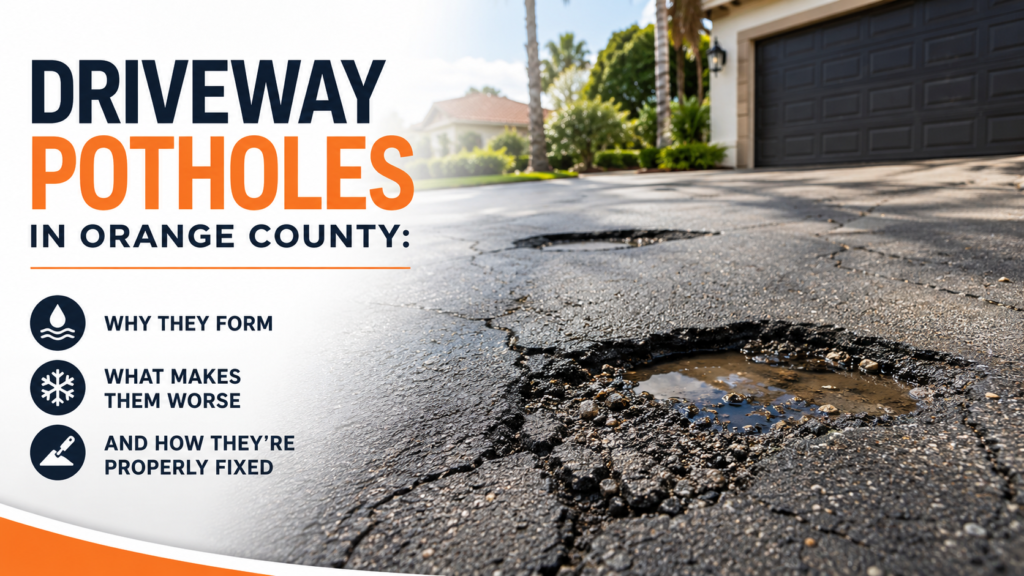
Potholes in Orange County driveways are a source of consistent frustration for homeowners they appear seemingly suddenly, grow rapidly once they begin, and can cause vehicle damage if left unaddressed. Many homeowners assume that Driveway potholes Orange County are simply a matter of age or bad luck, but the truth is more specific and more useful: potholes form through a predictable chain of cause and effect that can be understood, interrupted, and prevented. Understanding that chain and why certain conditions in Orange County make it more active than in other parts of the country gives homeowners the information they need to protect their driveway investment and make good decisions when damage occurs.
The Pothole Formation Chain: How It Actually Works
A pothole does not spontaneously appear. It forms through a sequence of events that begins long before the surface fails. Understanding this sequence reveals both why potholes form and why surface-only repairs so frequently fail to provide lasting results.
Step 1: Surface cracking opens. Every asphalt driveway develops surface cracks over time. The primary driver in Orange County is UV oxidation Southern California’s high UV index causes the asphalt binder to harden and lose flexibility faster than in most U.S. markets. As the binder oxidizes, it shrinks slightly and becomes brittle, generating the network of thermal shrinkage cracks visible on aged asphalt surfaces throughout the county. Additional cracking can come from tree root pressure, subgrade movement in Orange County’s expansive clay soils, or heavy vehicle loading that creates fatigue cracking.
Step 2: Water enters the crack system. Cracks in the surface are pathways for water to reach the pavement’s structural layers below. In Orange County, water entry occurs most dramatically during the El Niño rain events that periodically bring concentrated rainfall to Southern California, but even the morning marine layer leaves moisture that can infiltrate existing crack systems. Irrigation systems adjacent to driveways are a particularly underappreciated water source many Orange County residential properties have landscape irrigation that deposits water directly against or under the driveway edge.
Step 3: The base softens. Once water reaches the aggregate base below the asphalt, it saturates the material and reduces its load-bearing capacity. A properly draining base sheds this water quickly; a base that is poorly graded, that sits over poorly permeable subgrade soil, or that has been contaminated with fines over time retains moisture and remains in a weakened condition. Orange County’s clay subsoils which are prevalent throughout much of the county’s residential landscape drain slowly, meaning that saturated base conditions can persist for days after a rain event.
Step 4: Vehicle loads break the surface. The asphalt surface above a softened base no longer has adequate structural support. Vehicle loads that the pavement managed easily when dry now cause the surface to deflect to flex downward under the wheel load. Repeated loading fatigues the already-cracked surface. The combination of existing cracks and inadequate subbase support causes the surface to break into pieces, and those pieces are progressively ejected by traffic, creating the characteristic bowl-shaped depression of a pothole.
This sequence has a crucial implication: by the time a pothole is visible at the surface, the base beneath it has already been compromised. The failure began underground, not at the surface. This is why temporary cold-patch repairs simply filling the surface depression with ready-mix patch material fail so reliably. They address the symptom (the surface hole) without addressing the cause (compromised base and water infiltration), and the patch fails within weeks or months as the underlying failure continues.
Why Orange County Driveways Are Particularly Vulnerable
While potholes can form in any climate, several specific factors make Orange County driveways more vulnerable than those in many other regions.
UV intensity is the highest concern. Southern California’s UV index driven by the combination of high sun angle, low humidity, and relatively clear skies creates one of the most UV-aggressive environments in the continental United States for asphalt binder. The binder oxidation process that opens cracks and makes the surface brittle proceeds faster here than in cloudier, more humid regions. A driveway that might maintain surface integrity for 8 to 10 years before significant cracking in the Pacific Northwest may show equivalent deterioration in 4 to 6 years in Orange County under the same traffic conditions.
Clay subgrade variability affects many Orange County residential areas. The Expansive Soils Map of Orange County shows significant clay soil presence throughout the county, particularly in the inland areas of Anaheim, Fullerton, Orange, and the communities of the Chino Hills and Santa Ana Mountain foothills. Expansive clay soils shrink and swell with moisture changes, creating differential movement that stresses the pavement structure from below. Driveways over expansive clay soils that experience moisture variation from wet winter periods to dry summer periods, or from landscaping irrigation patterns that change seasonally experience more subgrade-driven cracking than those over more stable granular soils near the coast.
Landscape irrigation is an Orange County-specific concern. The county’s beautiful year-round landscape requires irrigation, and in many residential settings, irrigation systems are installed adjacent to or beneath driveway areas. As irrigation patterns change, as systems age and leak, or as root systems from nearby plants divert irrigation water toward the driveway edge, the base beneath the pavement can experience repeated wetting cycles that accelerate softening and pothole formation.
Heavy occasional loading is a pothole trigger specific to residential driveways in ways that commercial lots manage through design. Residential driveways are typically designed for passenger vehicles the standard residential pavement section of 3 inches of asphalt over 4 to 6 inches of aggregate base is appropriate for cars and light trucks. But moving vans, delivery vehicles, and other occasional heavy vehicles impose loads far beyond the design assumption. A fully loaded moving truck can weigh 26,000 pounds or more more than a dozen passenger vehicles. A single delivery event from a heavy truck can initiate the base distress that eventually becomes a pothole.
Irrigation System Water and Driveway Edges
The interface between a driveway and adjacent landscape areas is one of the most common locations for pothole development in Orange County residential properties. Water from irrigation systems installed in parkways, planters, or landscape areas adjacent to the driveway infiltrates the soil immediately adjacent to the pavement edge. Unlike the central area of the driveway, where the aggregate base is protected from below by subgrade soil and from above by the asphalt surface, the driveway edge has a direct pathway for water to enter the base from the side.
This edge infiltration saturates the base laterally, creating a zone of weakened base material that extends inward from the edge. As this weakened zone is loaded by vehicles (tires frequently track near or at the driveway edge, particularly near the garage), the edge begins to crack and deteriorate. The characteristic “edge cracking and raveling” visible on many Orange County driveways starts with this irrigation-driven lateral base saturation.
Addressing this mechanism requires both repairing the existing damage and correcting the irrigation system behavior. Driveways with significant edge deterioration that are repaired without adjusting adjacent irrigation patterns will re-develop the same edge deterioration within one to three years. An irrigation professional can audit the system and adjust head placement, direction, and timing to minimize water deposition against the driveway edge.
How Potholes Are Properly Fixed
Permanent pothole repair in Orange County driveways requires addressing the full failure chain, not just the surface symptom.
Assessment is the first step. Before any material goes into the hole, a professional contractor evaluates the extent of base compromise. Tapping the asphalt with a hammer around the pothole perimeter reveals the extent of the weakened area sound asphalt produces a sharp, solid sound; asphalt over a failed base produces a hollow or dull thud. This assessment defines the repair boundary beyond the visible hole.
Full-depth removal establishes the repair area. The pothole repair boundary is sawed or cut to a square or rectangular perimeter extending beyond the failed zone to solid pavement. The perimeter cut should be made with a concrete saw to create clean, vertical edges. All failed asphalt and base material within the cut area is excavated and removed. The base is inspected if it is dry, well-graded, and stable, it can be compacted in place and used as the repair base. If the base material is wet, contaminated, or broken down, it must be removed and replaced with clean, properly graded aggregate compacted to specification.
Base repair follows if needed. Fresh aggregate base material is placed in the excavated area and compacted with a plate compactor or jumping jack compactor. This is the most critical step for repair durability inadequately compacted base material will settle over time, causing the new asphalt above it to crack and fail at the repair boundary.
Hot mix asphalt fill restores the surface. Hot mix asphalt delivered from an asphalt plant at 275 to 325°F is the appropriate material for permanent pothole repair. Cold patch products available at hardware stores are appropriate only for emergency temporary repairs; they do not achieve the compaction density, adhesion, or durability of hot mix asphalt. The hot mix is placed in the prepared, clean, tack-coated repair area in lifts appropriate to the available compaction thickness and compacted with a hand roller or mechanical roller to achieve proper density. The finished repair should be flush with or very slightly above the surrounding pavement to allow for minor post-compaction settlement.
Prevention: Stopping Potholes Before They Form
The most cost-effective pothole management strategy is prevention interrupting the failure chain before it progresses to the pothole formation stage. In Orange County’s UV-intensive environment, the two most impactful preventive measures are sealcoating and crack sealing.
Sealcoating applied every two to three years fills the surface micro-voids through which water infiltrates, slows UV binder oxidation, and maintains a water-resistant surface film that keeps moisture from reaching the base. A consistently sealcoated Orange County driveway develops cracks later and more slowly than an unsealed one, pushing the entire failure chain and potential pothole formation years further into the future.
Crack sealing with flexible rubberized sealant closes existing cracks before they allow water infiltration. The timing of crack sealing matters: cracks sealed before water has penetrated to the base prevent base saturation; cracks sealed after water has already softened the base may slow additional infiltration but cannot reverse the damage already done. Fall crack sealing after summer heat has caused maximum crack opening and before the concentration of winter rain events is the optimal timing for Orange County driveways.
Common Questions About Driveway Potholes in Orange County
Can I repair a pothole myself with a product from the hardware store? Cold patch products provide a temporary repair that typically lasts weeks to a few months before failing. They are appropriate for safety patching to eliminate a trip or vehicle hazard while awaiting professional repair. They do not provide a lasting structural repair because they cannot be properly compacted, do not bond adequately to the surrounding pavement, and do not address the base failure beneath the pothole.
Why do potholes seem to appear all at once after heavy rain in Orange County? Winter rain events saturate existing crack systems rapidly, carrying the base saturation that has been developing for months to the point of surface failure within a short window. The pothole “appears suddenly” because the final triggering event the concentrated vehicle loading on a saturated base happens quickly, but the process that made it possible (UV cracking, water infiltration, base saturation) has been developing since the last maintenance cycle.
How much of my driveway should be repaired vs. replaced? When potholes and alligator cracking are isolated to 25 percent or less of the driveway area, targeted full-depth repair followed by sealcoating of the full surface is typically the most economical approach. When distress covers more than 25 to 30 percent of the surface, or when the base has failed extensively, full resurfacing or replacement becomes more economical than repeated individual repairs. An assessment by a qualified Orange County paving contractor provides the site-specific answer for your particular driveway.